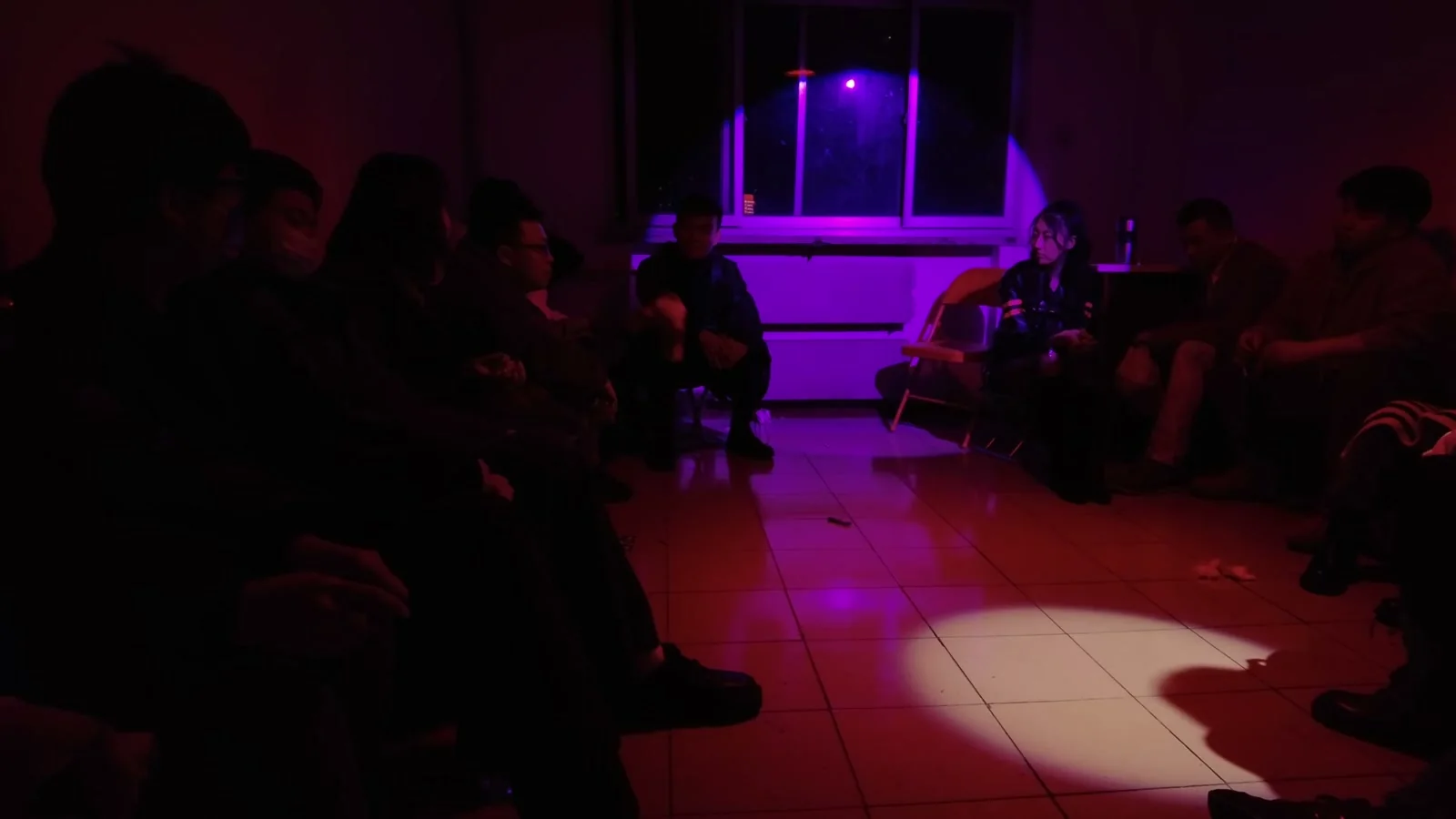
Site
Read the limits of an abandoned structure, office, boxing gym, bookstore or private room.
→
02 / 07
Space not as venue, but as a device for generating relations
P4 is not simply a venue. It is a long-term artistic system for producing works, relations, learning and collective experience.
Since 2015, He Fa has founded and directed P4 Theatre from Beijing. Its projects occupy abandoned factories, a 16-square-metre office, boxing gyms, bookstores, industrial sites and private rooms, making spatial limits, audience routes, participant identities and production conditions part of each work.
P4 does not produce a fixed style. It produces a method: Who may initiate? Who is permitted to watch? Who carries the failure? Performances, workshops, open calls, writing, moving-image records and long-term social ties all become material.
P4 SYSTEM / 2015–PRESENT
Read the limits of an abandoned structure, office, boxing gym, bookstore or private room.
→Participants’ identities, desires, hesitation and capacities enter the structure.
→Rules trigger action without guaranteeing a dramatic result in advance.
→Photography, film, text and sound alter the situation they document.
→The archive re-enters workshops, writing and further action; the system keeps growing.
PROJECT RESEARCH LAYER
P4 turns theatre from an art category into a working method. Each project begins with real constraints: a room that is too small, insufficient resources, non-professional participants and relations that cannot be simplified. Constraints are not concealed; they become structure.
Abandoned factories, offices, boxing gyms, bookstores and private rooms carry prior orders of labor, consumption, body and privacy. Each project works through those orders.
Non-professionals, friends, collaborators and spectators are not interchangeable material. Experience, capacity, fear and the wish to leave all modify the project in return.
Texts, open calls, images, sound and workshops are not secondary records. They become teaching material, memory devices and sources of dispute for the next action.
WORKING SEQUENCE
Identify existing power, circulation and traces of use.
Invite different forms of experience without assuming uniform performance skill.
Rules trigger relations without guaranteeing dramatic outcomes.
Keep incompletion, dispute and interruption in the long-term archive.
PROJECT COORDINATES
The continuing question
If theatre is first a method of organizing relations, where does the work begin—and where can it end?